
Abstract
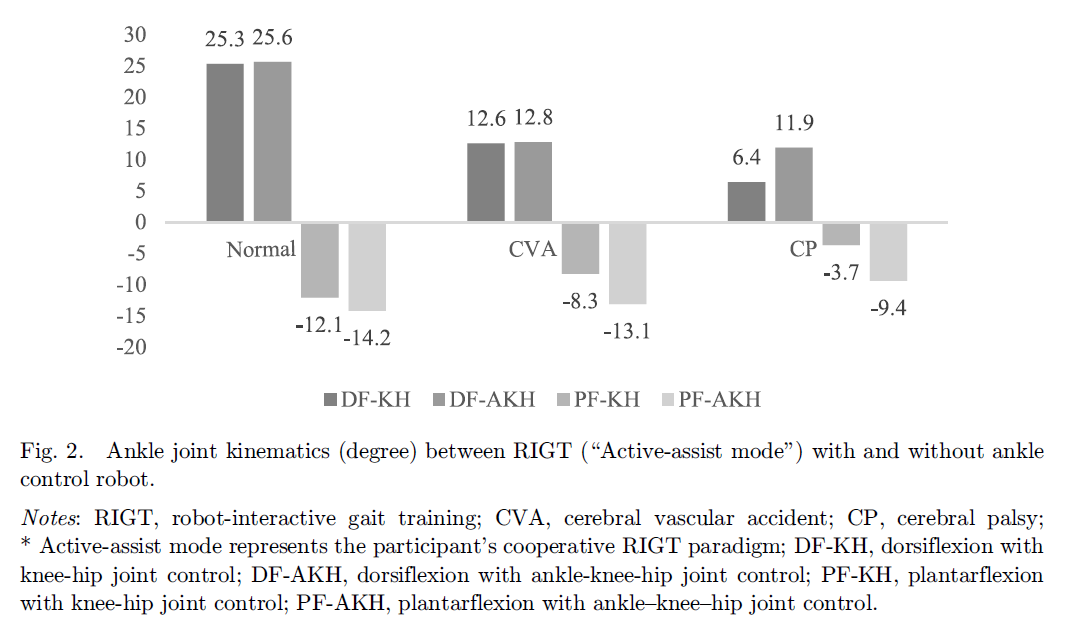
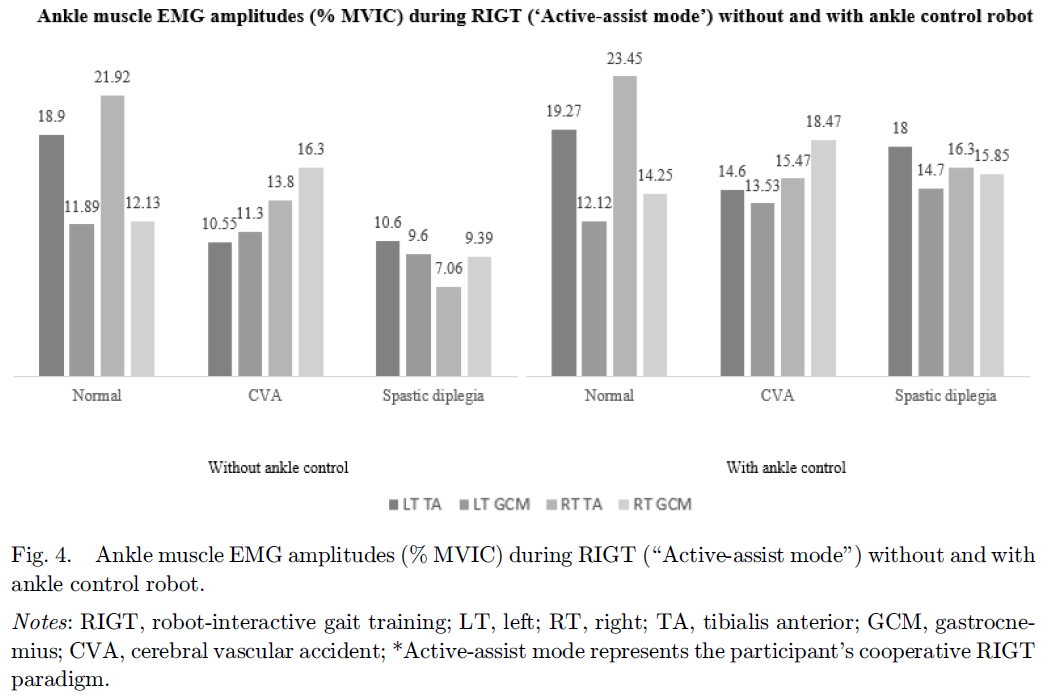
Although ankle robotic control has emerged as a critical component of robot-interactive gaittraining (RIGT), no study has investigated the neurophysiological and biomechanical effectson ankle muscle activity and joint angle kinematics in healthy adults and participants withbrain damage, including stroke and cerebral palsy (CP). This study compared the effects ofRIGT, with and without ankle control actuator, on ankle muscle activity and joint anglekinematics in healthy adults and participants with brain damage. Ten patients (healthy ¼ 4,left hemiparetic stroke ¼ 3, CP ¼ 3) underwent standardized surface electromyography(EMG) neurophysiological and kinematics biomechanical tests under the RIGT with andwithout ankle control actuator conditions. Outcome measures included the EMG amplitudesof the tibialis anterior and gastrocnemius muscle activity, and ankle movement anglesrecorded with a two-axis digital inclinometer. Descriptive statistical analysis demonstratedthat RIGT with ankle control actuator showed superior effects on EMG (30%) andkinematics angles (25%) than RIGT without ankle control actuator. Our results providednovel, promising clinical evidence that RIGT with ankle control actuator can more effectivelyimprove the neurophysiological EMG data and ankle dorsiflexion and plantarflexion movementsthan RIGT without ankle control actuator in participants with stroke and CP.
Conclusion
The clinical case series study demonstrated that RIGT with ankle control actuator is more effective in improving ankle EMG-controlled dorsiflexion and plantarflexion than RIGT without ankle control actuator in participants with stroke or CP. Our results provided clinical evidence-based insights on the utilization of robot interactive locomotor training with ankle control to maximize and develop recovery of ankle–knee–hip joint movement control, thereby improving walking safety, preventing falls, and thus, improving the quality of life and the activities of daily living.
DOI: 10.1142/S0219519421400352
Journal :Journal of Mechanics in Medicine and Biology, Vol. 21, No. 9 (2021) 2140035 (16 pages)
Published : 2 September 2021
